
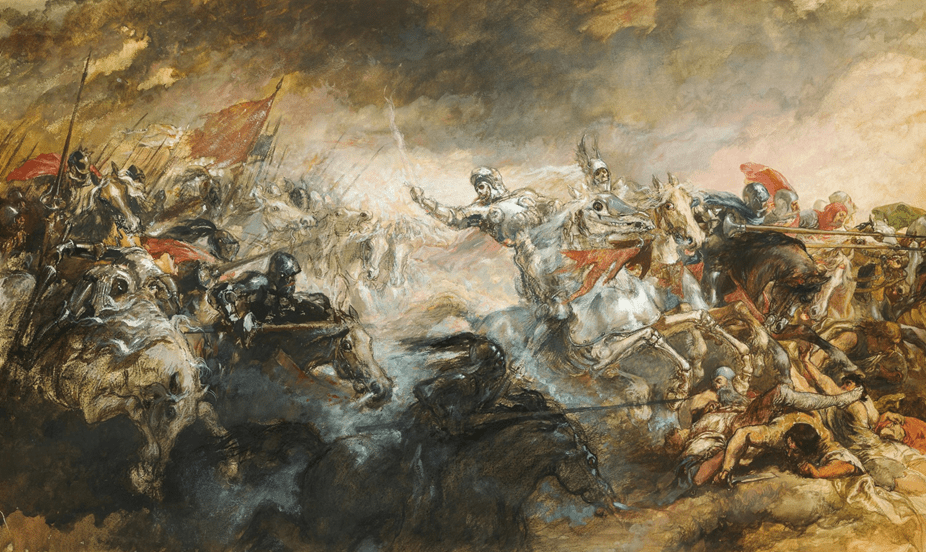
The Phantom Horseman,1870-93 by Sir John 1
Nothing is ever explained away more often by Christians than the ethical demands of Jesus’s sermon on the mount (Matt 5-7).[1] The whole purpose of the saying’s rest in counterintuitions, which is what elevates their contrasts. This is what Jesus wanted, a set of virtues that shines in all environments, exposing the flaws in behaviour patterns ingrained on the psyche by the systems we build and participate in. These patterns cycle the ages in an almost subconscious instinct. The whole ethical debate on violence perpetuates on all our ‘buts.’ Whatever ethic is presented we cannot resist hypothetically adding another situation which will test the boundaries of whatever is proposed.
We think we know what fair is, in the same way a child thinks justice means getting the same size slice of cake as their brother or sister on a birthday. If the parent accidently provides a smaller portion to one sibling a tantrum may ensue as the child screams injustice, yet that same child will happily say nothing if their portion is bigger than the others. Our sense of morality is rooted in an evolved hypocrisy, fortified in our ‘buts’.[2] The parent knows the futility of crying over a slightly smaller slice of cake because they have lived in a bigger world. So it is from Christ’s point of view, rooted in the Father’s character, when giving the sermon on the mount; it is Jesus’s ‘but’ to our ‘buts’, deduced not in contemplation of the world’s problems, but his knowledge of his own Father, who is consistent in his benevolence, despite seeing and knowing all.
Recognising my ignorant yet instinctive sense of justice, is the dilemma I have faced, in finding a decisive ethic around war and violence. The subject has multiple what if and what abouts, and the pressure to provide a proportionate response is immense. Which brother or sister is going to get the biggest slice of violence? And would a loving Father portion out slices through favouritism to begin with? Answering these questions would not be hard concerning your own family, but our instinct to project a God who thinks and acts as we do is so strong that they have become two of the most puzzling questions for the Christian to answer! This is where Jesus provides an ethic that fights normalised absurdity with disruption, as it is the only thing that will expose the absurdity that blinds us. Bloodlust is projected on our enemies in a similar way men throughout history have projected the blame for their lust on women’s clothing and appearance.[3] Guilt projection evolves until eventually everyone just plays roles instinctively, not realising their concept of good and evil stems from the same rotten tree. If this is the case, thinking things through will not work, I must cut my own arm off and poke out my own eye to balance the scale.
Looking into the subjects of war and pacifism, the concept of a ‘just war’,[4] has changed my mind, not in the sense of choosing a side, as that keeps the wars and ethical systems that support them going, but in the sense of needing to commit to turning the other cheek, and let Jesus say the final word on the matter. We must look at our what abouts as childish pouting to get more than we have been given. Jesus told us to turn the other cheek and not resist, and so we must be happy with it, and trust the one who we say we believe is wisdom and logic made flesh. Jesus sometimes confronted people’s what if and what abouts with a curt, “mind your own business and follow me” (Jn 21:22), and this is the path I must take when it comes to moralising violence and war. The reasoning behind Jesus’s counterintuitive ethic is not going to be found until I begin practicing it.
I have had times where I have fought back and resisted, and nothing good came out of it. Dropping some opponents with my fist in a basketball game didn’t stop me from being knocked unconscious and taking a trip to the hospital. At other times, I allowed myself to be hit in the face and chose not to retaliate, in one instance, the severe anger issue my opponent suffered, dissipated as soon as I told him I would not fight back as he expected, and something visibly snapped within him, as, encountered with his normative absurdity, his face showed the shock of someone who has never seen violence not answered with violence before. I was struck in the face by a security guard during the covid era for not checking in with a QR code to a public store, (with an app downloaded 20 million times in Australia that was used to track the health alerts of a total of two people) I chose to turn the other cheek, and saw a group of people for the first time think about the insanity of what they had begun normalising. Ministry needs a shock factor when disrupting pervasive patterns. Occasionally, in a boxing bout, a referee will refuse to step in to save a helpless fighter from being brutally knocked out, and the opponent becomes the one to stop attacking, before unnecessarily injuring or killing the other fighter. When it comes to war and violence, Christians ought to recognise there has been more than enough already and take responsibility to stop swinging.
The Christian Ethic concerning war should not cave to Situationism but maintain virtuous disruption. Lust is too ingrained inside humanity to be reasoned with, requiring a disruption of thought, rather than circular reasoning. This is why Jesus insists on extreme measures when dealing with lust and violence, fairness and proportion do not exist in those areas, and we must escape whatever perpetuates enmity as quickly as possible.
The questions of what about Christians who become soldiers and participate in war, are like the what if and what abouts concerning others Jesus told disciples not to concern themselves with, their business is theirs; Christ’s kingdom is mine. For the disciple, who’s Christian Ethic is rooted in the character of God revealed in Jesus, refusing to participate in violence, and act as citizens of a kingdom not of this world, is a difficult choice that may feel unjust.[5] The rich young ruler felt it unfair when asked to sell all his possessions (Matt 19:16-22), not everything Jesus asks makes immediate sense. This is the nature of having an ethical system not derived from what we have decided upon, but from the one who we declare to be Lord and master over our lives.[6] We must follow as best we can what was demanded by the master with what we have been handed.[7] If Jesus and his original disciples serve as our best examples of interpretation than a conclusion must be made that participation in war and violence is not our portion. Protective instincts may continue to come into play in various scenarios, like someone being attacked in front of you; but the process of joining the armed forces, planning and purposely going to war to kill enemies is a deliberate choice that does not reconcile with Jesus’s ethic of non-violence. It is a public participation in a cycle of bloodlust that Christians are to be instrumental in stopping. War gives no light of knowledge from the kingdom of God to either friend or enemy. Those who participate in violence in God’s name are not condemned, nor are they the business of those disciples who refuse to participate. Siblings may desire a different portion from time to time, but what we are given is ours to take and eat. I do not retain the right to justify war.
[1] Glen Harold Stassen and David P. Gushee, Kingdom Ethics: Following Jesus in Contemporary Context (Westmont: InterVarsity Press, 2014), 9.
[2] “Our transitory projects and personal desires obviously make it difficult to see goods as they really are, but distortions also happen with great goods like love of country, devotion to learning, dedication to a profession, or even commitment to our own version of the Christian stance.” Robin W. Lovin, An Introduction to Christian Ethics: Goals, Duties, and Virtues (Nashville: Abingdon Press, 2011), 82.
[3] David P. Gushee, & Glen H. Stassen. (2016). Kingdom Ethics, 2nd Ed. : Following Jesus in Contemporary Context (Second edition). Eerdmans, 139.
[4] Scott B. Rae, Moral Choices: An Introduction to Ethics, 4th ed (Grand Rapids: HarperCollins Christian Publishing, 2018),300-311.
[5] “To do justice after injustice, then, is to restore or create relationships that image God’s own perichoretic relationships.” James W. McCarty III, “Transitional Justice and the Trinity: A Christian Ethic for Reconciliation and Peacebuilding,” in ProQuest Dissertations and Theses (Ph.D., Emory University, 2014), 1614449220, ProQuest Dissertations & Theses Global
[6] Patrick Nullens, The Matrix of Christian Ethics Integrating Philosophy and Moral Theology in a Postmodern Context, with Ronald T. Michener (Downers Grove: InterVarsity Press, 2014) 149,150.
[7] “We Christians who, as I hope to show, are inextricably committed to a peaceable world, believe that peace is possible only as we learn to acknowledge and serve the Lord of this world, who has willed to be known through a very definite and concrete history.” Stanley Hauerwas, The Peaceable Kingdom: A Primer in Christian Ethics, Reprinted (Notre Dame, Ind: Univ. of Notre Dame Press, 2004), 6.
 fierystones.com